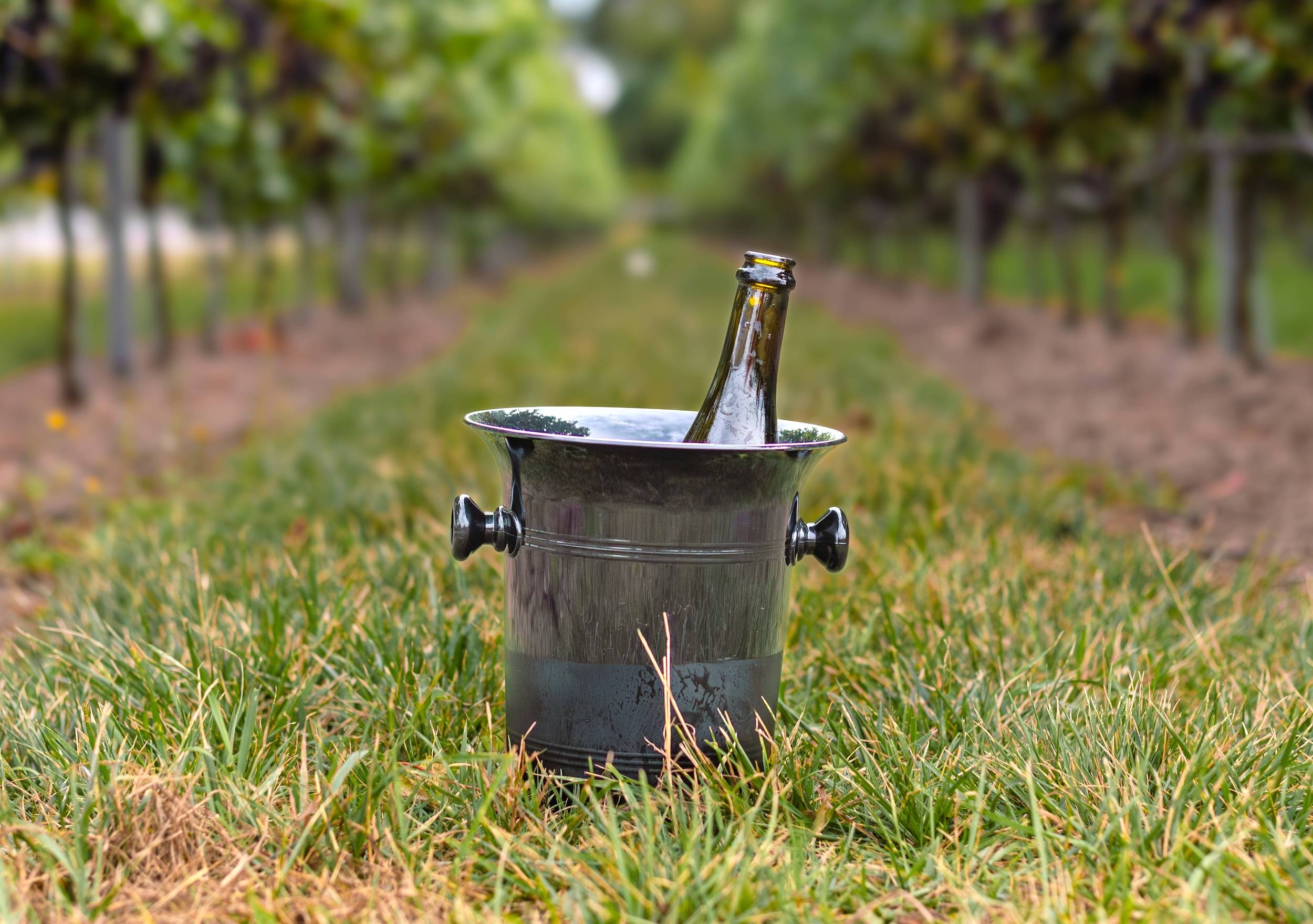
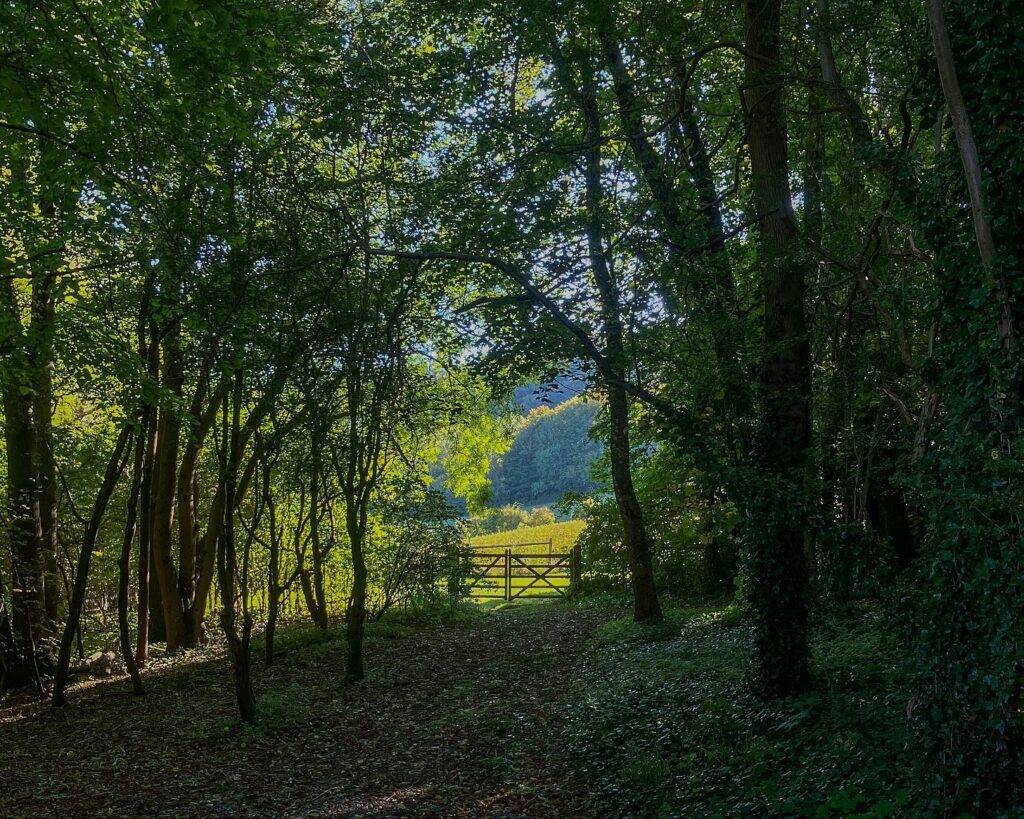
High up on the South Downs Way, past Ditchling Beacon on the way to Lewes, the landscape opens up. The alkaline path lies underfoot, the sea stretches out to the south, and the quiet order of fields roll away to the north. But somewhere below, folded into the undulating escarpments and barely visible from the narrow lanes that wind at their base, lies Mount Harry: a steep, easterly-facing, pure chalk vineyard, sheltered by slopes that guard against the winds that rush up the Channel.
This is where Dermot Sugrue, the Irish winemaker at the forefront of English sparkling wine, has anchored his most personal and ambitious work. The vineyard sits at the heart of Sugrue South Downs, a project that began as a side venture nearly two decades ago and has since become one of the most compelling stories in English wine. Today, the ever growing project is a shared vision, run together with his wife, Ana, a skilled winemaker whose influence and intuition have been central in shaping its direction and identity.
By the time Mount Harry came into the fold, Sugrue had already established his reputation. First at Nyetimber, where he sharpened the pioneering producer’s focus on quality, and then, more significantly, at Wiston Estate, where he built a winery from the ground up, shaped the house style, and emerged as the country’s go-to contract winemaker, quietly responsible for dozens of wines bearing other people’s labels.
Mount Harry wasn’t the start of Sugrue’s story, or even of Sugrue South Downs, but it marked a turning point. To see where the story truly began, you have to go back, before Mount Harry and Wiston Estate, to the tail end of his time at Nyetimber, when the seeds of something more personal were first being planted.
From the Carthusian monks of Burgundy to the Cistercians of Champagne, monastic orders across Europe have long had an affinity for growing grapes and making wine. In 2006, that legacy echoed in an unlikely corner of England, when the priests of the Our Lady of England Priory in Storrington, West Sussex, asked Dermot Sugrue for help planting a vineyard.
Together, they established a modest 1 hectare plot (now 1.6 hectares) on gently sloping land in the northern shadow of the South Downs. For Sugrue, it marked the start of something independent, a chance to forge his own style outside the framework of an established estate. The first harvest in 2008 never made it to bottle, the grapes lost to hungry birds, but from 2009 to 2011 the vineyard became the sole source for his debut cuvée, The Trouble With Dreams.
The Trouble With Dreams embodied Sugrue’s vision for English sparkling wine: Chardonnay led blends for purity and freshness, vivid natural acidity left untouched by malolactic conversion, depth from long lees ageing, and texture from fermenting part of the wine in old Burgundy barrels. For over a decade, it was his only cuvée, a single wine standing for the man, the project, and the idea.
Though The Trouble With Dreams has evolved over the years to incorporate new sites, its DNA remains unchanged and the 2020 vintage captures that philosophy at its most articulate. Shaped by a warm, even growing season, it shows the wine’s core identity with particular clarity.
The nose is bright citrus, warm pastry, lemon zest. The palate delivers on that promise, citrus crackling across a fine line of acidity, backed with patisserie finesse, quiet textural breadth and gentle oxidative hints of hazelnut. The Trouble With Dreams avoids the heavy autolytic style seen in some English sparklings, instead holding tension and generosity in balance. 93
2012 was the wettest, coldest, darkest summer in a century, and Storrington Priory yielded no fruit. After five vintages Sugrue had managed just three releases, a reminder of how exposed a single-site project can be to the vagaries of English weather. If the philosophy was going to endure, it needed a broader foundation.
What emerged was Sugrue South Downs as it now exists. Not a singular estate, but a network of carefully chosen vineyards. This model was designed to withstand the bad years, amplify the good, and build identity through the character of its sites.
As fortune had it, one site, also planted in 2006, had quietly become available to lease: Mount Harry. Dug into shallow loamy soils over pure chalk, 80 metres up on northern escarpment of the South Downs, it had been established by Tim Renton, a former Tory minister in the waning days of the Thatcher government, and his wife Alice. At 2.2 hectares, it more than doubled the area under vine. But it was the Chardonnay on chalk that resonated most with Sugrue, a combination he had come to prize at Wiston. From then on, Mount Harry became central to the project, contributing regularly to The Trouble With Dreams and, in strong vintages like 2020, earning its own platform.
That wine is Cuvée Boz, a blanc de blancs named for Sugrue’s late brother. From the bountiful 2020 vintage, it shows pale gold in the glass, with aromas of lemon zest, pear, and praline. With no malolactic conversion, the palate is unapologetically citru driven, edged with green apple, and carried by a bracing, linear spine. Lees ageing and low dosage (5g/L) adds a quiet, polished texture without dulling the drive. It’s thrilling now, but the structure suggests years of evolution ahead. For me, it needs a little time for that tension to settle. 92-94
The final piece of the Sugrue South Downs vineyard puzzle is Coldharbour. Set 25 miles west of Mount Harry, at the foot of Bignor Hill, this 7.35 hectare site sits in a natural amphitheatre of clay and flint over chalk, shielded by woodland and sheltered from the sea. In many ways, the site is similar to Mount Harry.
Coldharbour was planted by Nyetimber in 2005, when Sugrue was still their head winemaker, and it has never drifted far from his orbit. Since 2011 he has made every sparkling wine from the vineyard, first under the Coldharbour brand name, until the Hunt family, who own the site, chose to step back from their own label and supply all the fruit to Sugrue instead. In 2022 the relationship was sealed with a long-term exclusive lease, almost tripling Sugrue South Downs’ holdings. The vines are tended by a small team, Liesa Davey and Geoff Hall, whose knowledge of the land runs deep.
While much of its fruit supports The Trouble With Dreams, Coldharbour has also earned its own spotlight. In 2018, a parcel of Pinot Noir and Meunier showed such aromatic clarity and finesse that Sugrue decided to make a sparkling rosé from the site for the first time. Made by the assemblage method rather than saignée, a deliberate choice for control over colour and flavour, the result was Rosé Ex Machina, a blend of 70% Pinot Noir, 20% Meunier, and 10% Chardonnay.
The wine is immediately striking. Pale rose gold in the glass, brushed with a hint of burnished copper, it moves from blood orange and wild strawberry to soft cream and apple blossom. On the palate, that vivid Sugrue acidity takes hold, orange, grapefruit, and citrus zest, yet it’s broad and munificent too. Pinot gives it breadth and lift, making this a more open, generous expression of Sugrue’s precision. Expansive but still focused, it stays bright, poised and alive in the glass. 94
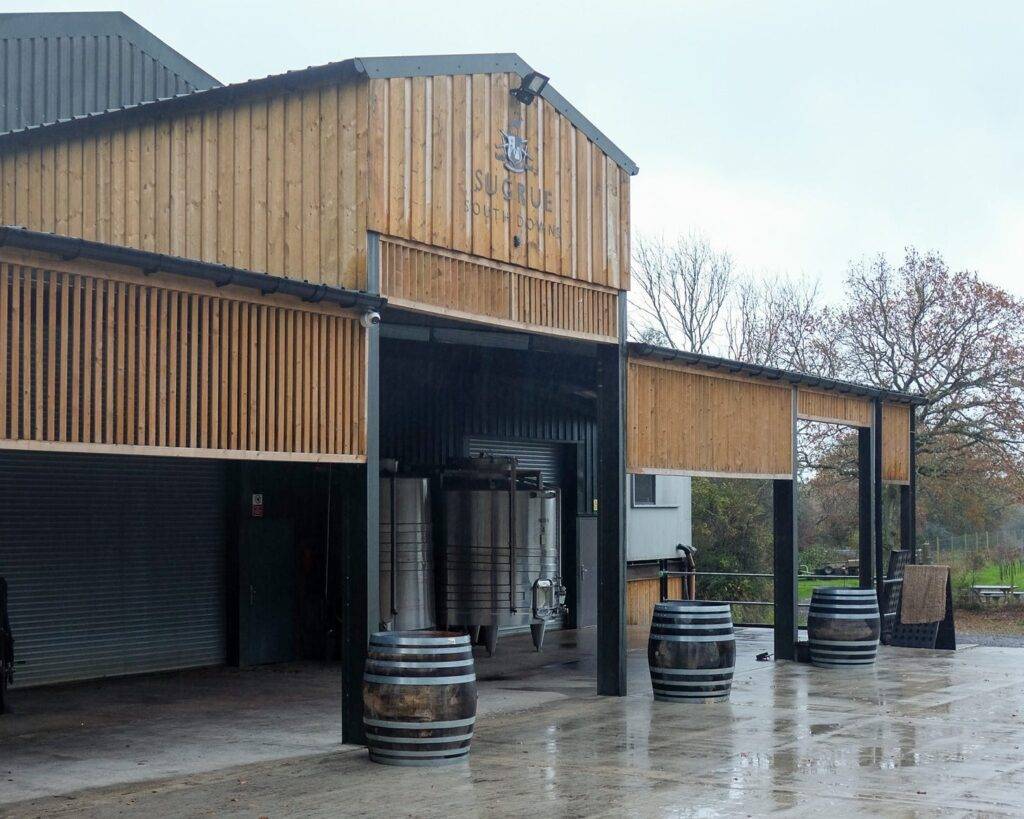
Coldharbour marked a turning point in scale, but the real shift came with the building of a dedicated winery. Just south of Wivelsfield Green, a short tractor run from Mount Harry, the Bee Tree Winery finally gave Ana and Dermot full control, an inevitable step once Dermot left Wiston Estate in 2022 and their reliance on borrowed space came to an end. With Coldharbour under lease and ambitions widening, the moment was right: if the wines were to express their sites with complete clarity, everything, from pressing to fermentation to ageing, had to live under their own roof.
The winery also came with a vineyard attached, a clay rich site planted to Pinot Noir and Meunier. It didn’t fit the classic Sugrue profile, which leans chalk and Chardonnay, but it offered a chance to explore broader ground, work with different soils, and create a second label with a looser tone. That became Bee Tree by Sugrue: a fruit forward, relaxed, Pinot driven foil to Sugrue South Downs’ detail and discipline.
Still wines have now entered the frame too. First came Bonkers, or to give it its full name, Bonkers Zombie Robot Alien Monsters From The Future Ate My Brain (Sur Lie), a solera aged Chardonnay now on its second release. Then Dear Noodles, a vivid still rosé; and most recently, Crouch Valley Pinot Noir from Essex, perhaps England’s most promising region for serious red wine.
Around all this, the circle of collaborators has widened. Backers now include wine writer Hugh Johnson, chef Angela Hartnett, and Robin Hutson from the The Pig Hotels group, all aligned in the belief that English wine belongs at the top table. Their involvement has helped place Sugrue’s wines in some of Britain’s most refined dining rooms and helped inspire a discreet, high end model of wine tourism: intimate dinners and tastings hosted by Dermot and Ana at the winery, often alongside leading UK chefs.
Ultimately there’s a modernity to Sugrue that few Sussex producers can match. Ana and Dermot understand the full shape of the proposition. From the clean, monochrome labels to the unapologetic naming, every release feels intentional. Tasting through the range, I kept returning to the sense of continuity running through the wines. They’re varied, each occupying their own space, but linked by a through line of acidity, intent, and a willingness to push at the edges of what English sparkling can be. In a region without centuries of accumulated knowledge to fall back on, where winemaking customs are still taking shape, these wines feel distinctly self defined: cut from the same sharp, uncompromising mindset that treats the wine, the vineyard, and the message as parts of the same whole.
The Irish have a phrase, the Winegeese, used to describe the diaspora of Irish émigrés who went abroad and found new lives through wine, most famously in Bordeaux, Burgundy, and Spain. In carving a path across the South Downs, Sugrue feels like a continuation of that legacy: rooted in Ireland, reshaping England, working with the same restless, world building intent.
For more articles from Charlie visit his page – www.englishwine.substack.com