There’s a version of Croatia you see on everyone’s Instagram: the city walls of Dubrovnik glowing gold at sunset, turquoise water so clear it looks edited, a boat anchored somewhere outrageously scenic while someone sips local wine. Here’s the thing — it actually looks like that. The Dalmatian coast is genuinely, almost unfairly beautiful, and no amount of social media saturation has diminished that.
What it has done is made the crowds at peak summer feel like a mild form of punishment. But get the timing right, or venture a little off-script, and this stretch of the Adriatic — Split, the surrounding islands, and Dubrovnik — is as good as travel gets.
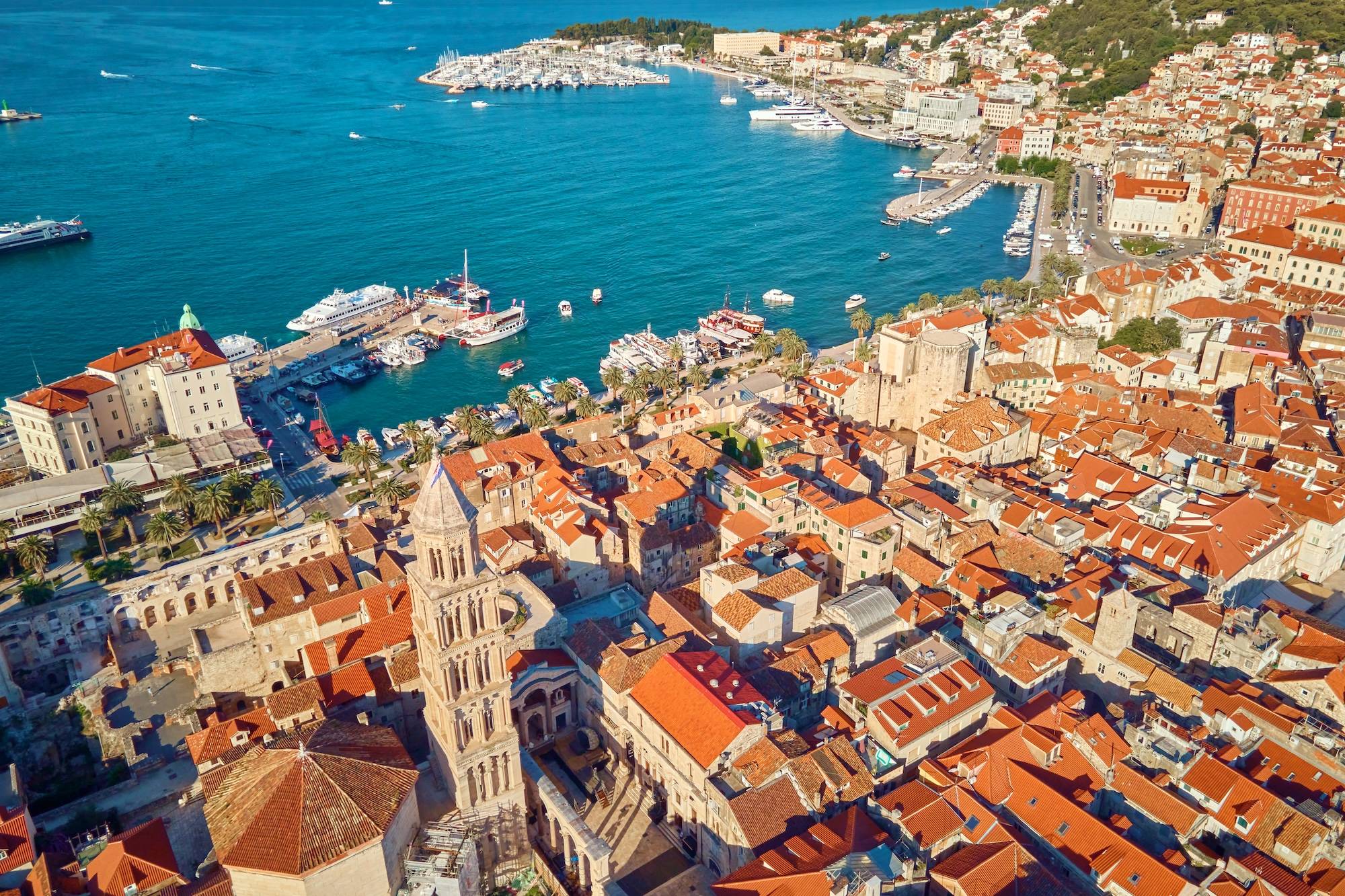
Most people treat Split as a gateway to the islands. This is a mistake. Split deserves at least two proper days, not least because its centrepiece — Diocletian’s Palace — is unlike anything else in Europe.
This isn’t a palace in the sense of a building you pay to walk around. It’s a living, breathing quarter of the city: 1,700 years old, a UNESCO World Heritage Site, and still fully inhabited. People live here. Restaurants operate inside Roman columns. A hotel occupies the palace’s former cellars. Locals hang washing between ancient stone arches. Parts of it were used as filming locations for Game of Thrones, though the residents seem magnificently unbothered by that fact.
You can wander the palace grounds for free. Do it first thing in the morning, before the tour groups arrive, and the place is almost serene.
Vestibul Palace sits directly inside Diocletian’s Palace — literally within the ancient walls — and has just seven rooms and suites. The design plays a brilliant trick: original Roman stonework sits against minimalist glass and brushed steel, exposed brick against ambient lighting. Sleeping here, with 1,700 years of history pressing gently against the walls, justifies every kuna. vestibulpalace.com
Judita Palace Heritage Hotel occupies a 16th-century palace right on the main square, its architecture a beautiful palimpsest of Roman, Gothic, and Renaissance influences. Intimate, characterful, with an internal courtyard that feels like a secret the city hasn’t told anyone else. judita-palace.com
Konoba Fetivi has a Michelin Bib Gourmand and the kind of reputation that means you should book ahead. The grilled fish is caught that morning and cooked over an open flame with little ceremony and great results — exactly how fish this fresh should be treated. The black risotto is the colour of midnight and tastes like the sea itself. The slow-cooked pašticada (beef braised in prunes and wine) is for when you’re committed.

Zrno Soli, the name meaning “grain of salt,” is Michelin-recommended and worth it. The cooking takes Dalmatian ingredients seriously and treats them with a light, modern touch. Go for the tasting menu if you can.
Konoba Matejuška sits at the edge of the Old Town, rustic and straightforward. Grilled seafood, octopus salad, very decent house wine, and a crowd that’s mostly local. No reservations, no fuss. Go early.
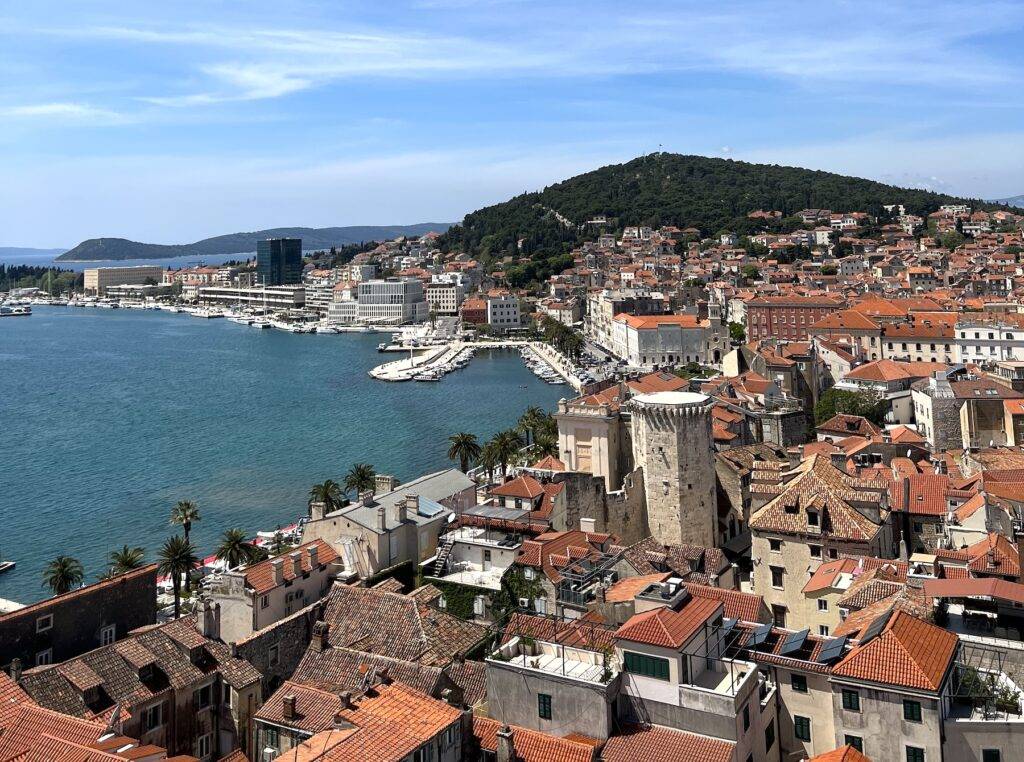
Marjan Hill is Split’s own nature reserve, a pine-covered headland that rises directly behind the city and offers the best panoramic views you’ll find without paying for a cable car or a restaurant table. There are walking trails up through the trees — some leading to old cave hermitages, which are exactly as atmospheric as they sound — and once you’re at the top, the view takes in the whole bay, the islands, and the city below. Free, easy, and far less crowded than it should be.
Bačvice Beach is where locals actually swim — a shallow sandy bay just a short walk from the Old Town where you can watch Croatians playing picigin, a uniquely Dalmatian game that involves five players standing in shallow water hitting a small ball to each other with dramatic athleticism. It has the energy of a sports match crossed with a performance art piece. Free to watch. Admission: just show up.
The Green Market and Fish Market are side-by-side near the Old Town waterfront. The Fish Market (peškarija) is the older of the two — all gleaming scales and shouted prices — while the Green Market sells local produce, olives, cheese, and the kind of tomatoes that actually smell like tomatoes should. Browse both without spending a thing, or pick up provisions for a picnic on Marjan Hill.
The Riva is Split’s long waterfront promenade — wide, palm-lined, and designed for a particular Croatian skill: the slow evening walk, known as the korzo, in which the entire city seems to dress up slightly and stroll back and forth while greeting acquaintances. Join in. It costs nothing and is deeply pleasant.
For something to actually take home, the Green Market sells local olive oil, lavender products, and honey that will remind you where you’ve been long after the tan has faded. For something more considered, look inside the palace walls for small independent workshops selling handmade ceramics and silverwork. Uje, the Croatian olive oil brand with shops in both Split and Dubrovnik, is worth seeking out for beautifully packaged oils and condiments — their tasting bar lets you try before buying.
The Dalmatian islands are a buffet problem: too many excellent options, limited time. Here’s a quick cheat sheet.
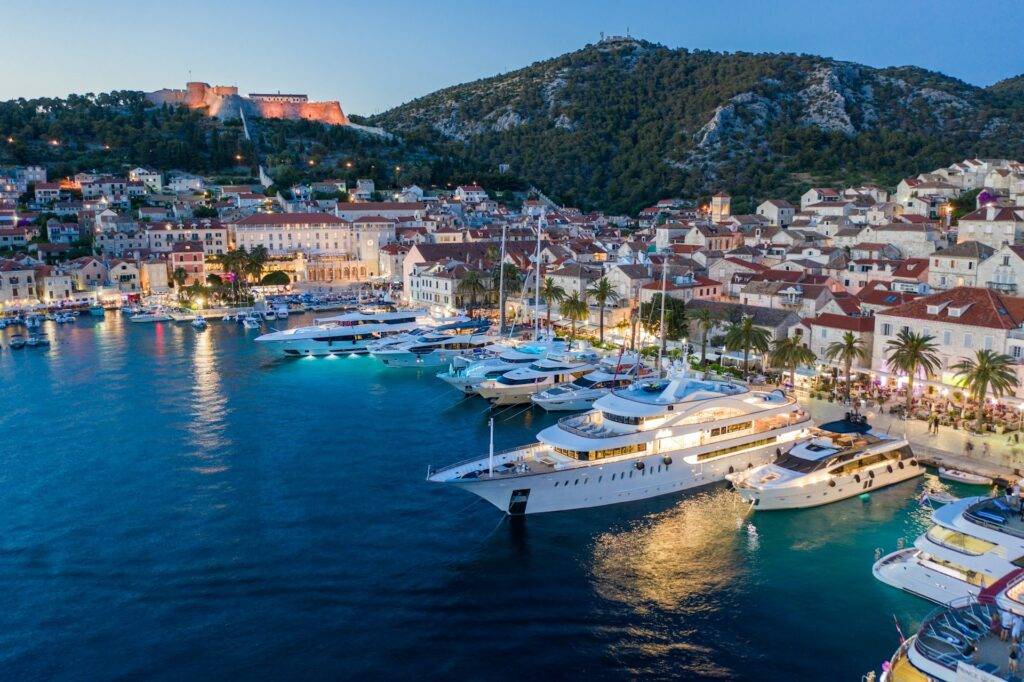
Hvar is Croatia’s most glamorous island, and it knows it. Hvar Town has a magnificent Venetian piazza, a 16th-century fortress brooding on the hill above, palm-lined waterfront, and restaurants serving some of the best food on the coast. It also, in July and August, contains an extraordinary density of superyachts and people who are very keen to be photographed in front of them. If that’s your scene, peak season Hvar delivers. If it’s not, go in June or September when the island reverts to something closer to its actual self.
The Pakleni Islands — a short water taxi ride from Hvar Town — offer the swimming you dreamed of: clear turquoise water, pine trees tumbling into the sea, almost nobody around. Take a picnic and stay all day.
For a sunset drink, Hula Hula beach bar on the coast path west of town starts playing music mid-afternoon and swells into a reliably joyful, slightly ridiculous sunset gathering that costs the price of a drink.
Where to stay: The Riva Hvar Yacht Harbour Hotel sits right on the harbour front and represents the island’s best hotel offering — contemporary rooms, sea-facing terraces, and a position that makes the people-watching essentially mandatory. rivahvar.hr
Where to eat: Hvar Town has an abundance of good seafood restaurants along the harbour. The key is to walk away from the main square before committing — the quieter streets behind have far better food at far lower prices.
Brač is often treated as the functional island — the one you go to for the ferry connection or a day at Zlatni Rat, the famous golden horn beach near Bol that actually shifts shape depending on the currents. It’s worth the trip, though arrive early if you’re going in summer.
Beyond the beach, Brač is the home of the Brač limestone that built Diocletian’s Palace — and, incidentally, the White House in Washington DC. The quarries at Škrip are genuinely interesting to explore. And Brachia olive oil, produced from the island’s ancient olive groves, is among Croatia’s finest. Buy it directly from a producer rather than from a gift shop.
Until 1989, Vis was a Yugoslav military base, closed to tourists. This late arrival to the visitor economy, combined with its remoteness (the furthest inhabited Croatian island from the mainland), means it has maintained a personality that the more accessible islands have gradually lost. No cruise ship day-trippers. Smaller crowds. Fishing boats that aren’t merely decorative. This is the island for people who quietly feel superior about their holiday choices, and on this occasion, they’re right.
Vis Town is the more elegant of the two main settlements, with Habsburg-era townhouses and a gentle pace. Komiža, on the western side, is the fishing village — rougher, saltier, and in its own way more beautiful.
What to do: The Blue Cave (Modra špilja) on the nearby islet of Biševo is the island’s headline attraction — a sea cave in which natural light refracts off the water to produce an eerie, otherworldly blue glow. Boat tours run from both Komiža and Vis Town. Worth every kuna.
Stiniva Cove, regularly voted one of Europe’s most beautiful beaches, is a narrow fjord-like inlet with water the colour of old glass. The hike down from the clifftop is steep and rocky. The payoff is proportionate.
Where to eat on Vis: Roki’s Tavern is surrounded by its own vineyards and serves traditional peka — meat and vegetables slow-cooked under a bell-shaped lid buried in embers, usually requiring a day’s notice. Worth planning around. Boccadoro in Vis Town has a lovely courtyard and serious Mediterranean cooking. Lola does something more unexpected: modern tapas and vegetarian dishes in a garden with a fountain and lemon trees, which sounds implausible on a Croatian island and works beautifully.
Vugava and Plavac Mali are Vis’s local wines. Order both, decide which you prefer, repeat as necessary.
Korčula’s old town is sometimes called “Little Dubrovnik,” and it has the same ingredients — medieval stone walls, terracotta rooftops, a harbour that turns amber in the evening light — but without the cruise ships, without the queues, and without the entry fee. This is not a small point.
The island also claims to be the birthplace of Marco Polo, a claim disputed by several historians and enthusiastically maintained by everyone on Korčula regardless.
Grk is a white wine grape grown only in the village of Lumbarda, at the eastern tip of the island, and nowhere else in the world. Light, mineral, and slightly austere, it’s the sort of wine that tastes better with place: drink it looking at the sea. Vitis Winery in Lumbarda is worth visiting for tastings.
The Moreška sword dance — a traditional battle dance performed in elaborate costume — runs on selected evenings in summer and is one of the more genuinely interesting local traditions on the Dalmatian coast.
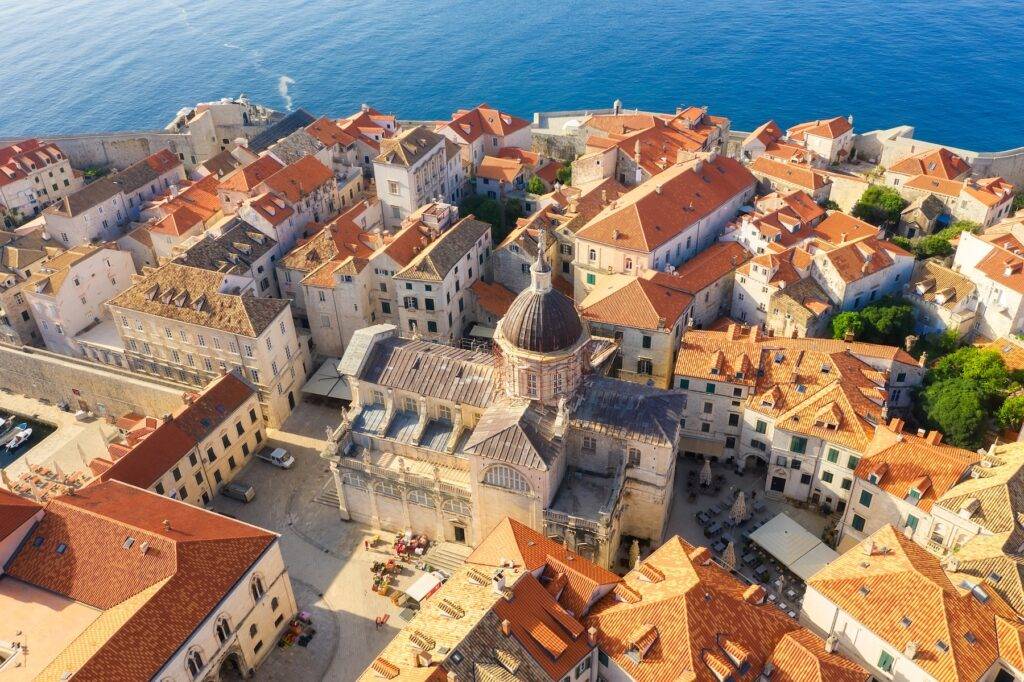
A word of honesty before we begin: Dubrovnik in peak summer is very, very busy. The cruise ships arrive before most people are up and disgorge thousands of visitors into a walled town designed for a medieval population. This is a known problem and the city has introduced measures to manage it, none of which have yet made the Stradun on a Tuesday in August a relaxing experience.
The solution is simple: go in May, June, September, or October. Or, if you must go in summer, schedule your mornings inside the walls and your afternoons on the water.
With that said: Dubrovnik is genuinely one of the most extraordinary places in Europe, and no number of tourists reduces the impact of those walls, that sea, and that particular quality of light.
The Pucic Palace is Dubrovnik’s finest hotel — 19 rooms in a superbly restored 18th-century baroque palace right in the heart of the Old Town, antiques and refined detailing throughout, and a breakfast terrace on Gundulićeva Poljana square. If you’re going to stay inside the walls (which you should, at least for part of a visit), this is the benchmark. thepucicpalace.com
Hotel Stari Grad is the quieter, more intimate alternative — nine rooms and five suites in a 16th-century nobleman’s house, with jewel-toned interiors that somehow feel contemporary and historic simultaneously. The rooftop restaurant is one of Dubrovnik’s better eating options. hotelstarigrad.com
Villa Dubrovnik sits just outside the walls on its own small coastal promontory, with a private boat shuttle to the Old Harbour. The architecture is cool and modernist, the rooms have proper sea views, and staying here offers the rare gift of Dubrovnik proximity without Dubrovnik noise. A legitimate option if the crowds inside the walls feel like too much. villa-dubrovnik.hr
Restaurant 360 occupies a section of the city walls themselves, with a terrace that looks out over the harbour and the Adriatic beyond. The food is innovative Mediterranean — technically accomplished and visually dramatic — and the view is the kind that makes people go quiet. Worth the splurge.
Konoba Dalmatino is the antidote: simple, honest Dalmatian cooking tucked into an alley off the Stradun. Grilled fish, prstaci (small Adriatic clams), and local wine served without theatre. The kind of restaurant the city would lose something without.
For breakfast and coffee, the café tables at Gradska Kavana Arsenal on the Old Harbour are genuinely pleasant for morning people-watching before the crowds build.
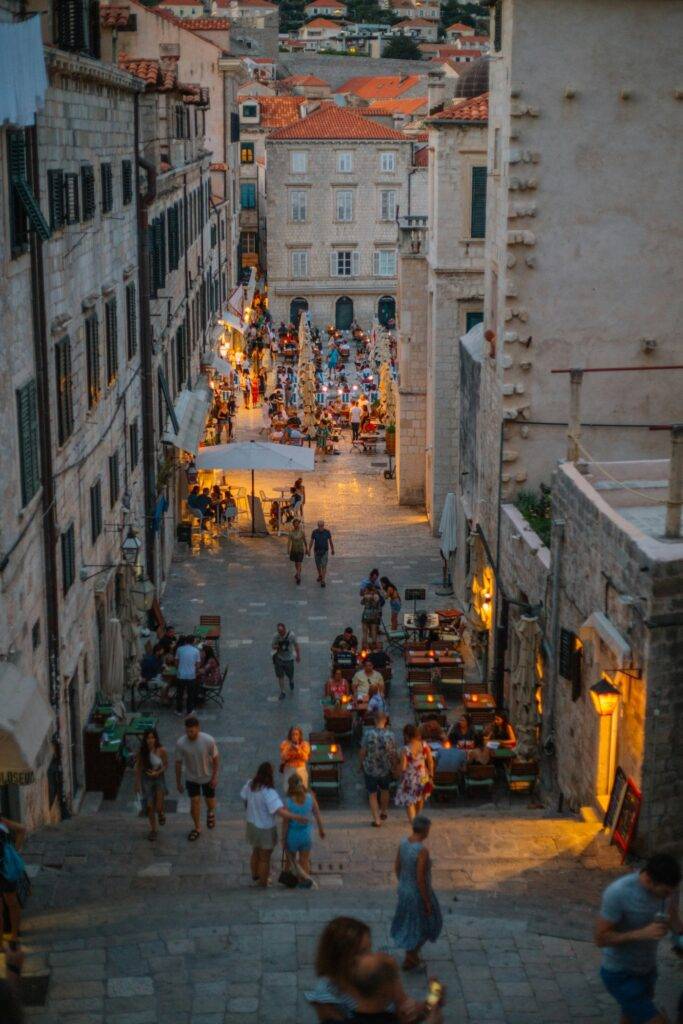
Walk the City Walls. Not free — the ticket costs around €35 — but arguably the best €35 you’ll spend in Croatia. The 2km loop around the top of the walls gives you the city from every angle: the rooftops below, the sea beyond, the medieval fortresses, and a scale of ambition in old stonework that impresses long after you’ve left. Go in the last hour before closing for the best light and the thinnest crowds.
Mount Srđ. The hill directly above Dubrovnik offers the most complete view of the city and the surrounding islands — and the hike up is free. It takes about an hour on foot via a marked trail. There’s a cable car if you’d rather not, but walking gives you time to appreciate how dramatically the Old Town sits in its geography. The fort at the top houses a small museum about the 1991-1992 siege of Dubrovnik.
Gundulićeva Poljana market. Open Monday to Saturday from 7am to 1pm, this morning market on the Old Town square sells fruit, vegetables, olive oil, lavender, honey, and local spirits. It’s where Dubrovnik residents actually shop, and it’s free to browse — though you’ll probably leave with something.
Banje Beach is Dubrovnik’s most accessible swimming spot, a five-minute walk from Ploče Gate, with views back to the Old Town and out towards Lokrum Island. No entry fee. Bring your own towel and arrive early.
Lokrum Island is a ten-minute boat ride from the Old Harbour (tickets around €27 return) and offers an afternoon of total contrast to the city: a 12th-century Benedictine monastery in ruins, a botanical garden, peacocks wandering freely around the grounds, a saltwater lake for swimming, and a hilltop fort with 360-degree views. The island is dense with black pines and extremely quiet by comparison with the mainland.
Gundulićeva Poljana market (mentioned above) is the first stop for quality local olive oil, lavender products, and craft spirits at reasonable prices. For something more considered, the Dubrovnik Treasures shop on Stradun carries quality Croatian design pieces. Look for hand-painted ceramics, local coral jewellery, and bottles of Dubrovnik-produced rakija (the local spirit, often made with honey, herbs, or cherry) in gift shops along the side streets rather than on the main drag, where prices climb with the footfall.
Split to the islands: Regular car and passenger ferries operate from Split’s main ferry terminal. Hvar is the easiest connection. Vis takes longer (around 2–2.5 hours) and services are less frequent, which is part of the point. Catamaran services are faster but passenger-only.
Between islands: Connections exist but aren’t always convenient. Island-hopping is possible by combining ferry routes with a bit of patience, or by chartering a boat, which is the best version of Croatian travel if budget allows. Even a half-day charter to reach a particular beach or cove delivers more return than almost anything else you could spend the money on.
Split to Dubrovnik: Around 4 hours by car or bus. The coastal road is spectacular but narrow in places and notoriously busy in summer. The direct catamaran is a pleasant alternative in season, with the added bonus that you arrive into Dubrovnik by sea, which is the correct way.
May and June are the sweet spot — warm enough to swim, light enough to see clearly, not yet at the summer density. The lavender fields on Hvar bloom in June and the island smells extraordinary.
September and October run it very close. The sea is at its warmest in September, the summer crowds have thinned, and the light takes on that particular golden quality that makes everything look like a film that was shot with a lot of money.
July and August are peak season in every sense: maximum heat, maximum crowds, maximum prices. Dubrovnik and Hvar Town particularly feel the pressure. If you go, plan around it: early mornings and late evenings in the city, afternoons at sea.
Book ahead. The best restaurants on the islands and in Dubrovnik fill up. Roki’s on Vis requires a day’s notice just for the peka. Don’t rely on walk-ins anywhere decent in summer.
Carry cash. Croatia adopted the euro in 2023, which simplifies life. But smaller restaurants, market stalls, and boat taxis on the islands sometimes still prefer it in hand.
Be realistic about Dubrovnik’s Old Town in summer. It’s brilliant, it’s crowded, and you can love it while also accepting that the midday scene on the Stradun in August is not a slow, reflective experience. Work with the city’s rhythms rather than against them.
The islands will slow you down. Let them. Croatia’s Dalmatian pace — long lunches, late evenings, the concept that a swim after lunch is a perfectly reasonable use of an afternoon — is one of the genuine pleasures of the trip. Don’t fight it.
Rent a scooter on Brač or Korčula. Both islands are manageable on two wheels and considerably more fun that way. Roads are quiet, distances are short, and the views from the hillsides en route to beaches you’d never otherwise find are worth every minute.
The Dalmatian coast has been famous long enough to have developed a mythology slightly bigger than its reality. But the reality is still very good. The sea is still that colour. The food is still that fresh. The evenings are still that warm. Croatia has earned its reputation. Just earn yours by doing it properly.
For more places and guide-trip stays worldwide, check out our guide to 10 hotels worth the visit!