British auteur discusses an obsession with analogue, the magic we can’t explain and his new film, Rose of Nevada
There are two ends of the creative spectrum. You can bring work into being fully knowing what shape it will take from the outset, or you can enter into a project with an open mind – allowing everything from your medium to environmental dynamics to leave their mark on the finished product. Mark Jenkin is the first to acknowledge he falls into the latter way of working.
For a filmmaker on the cusp of major recognition, it’s not a careless admission or false modesty. Cinema, like almost any artform, is most potent when resisting tidy explanations. It slips between categories, evades labels, and lives somewhere closer to memory or dream than narrative certainty. His new feature, Rose of Nevada, is exactly that kind of film: tactile, immersive, elusive, and quietly overwhelming.
“I think so,” he says, when I ask if he’s happy with it. “It’s quite difficult to have any distance on it. At the moment, it’s a little bit easier now, because I’m getting feedback… being told what people think about it.”
We are speaking in that strange liminal window between completion and release. This is the period Jenkin describes as the most psychologically precarious stage of filmmaking. The film is finished, locked, and no longer malleable. But it hasn’t yet met its audience.
“That time between finishing it and the premiere,” he continues, “that’s when I really don’t know what it’s like. Especially when there’s a bit of expectation about it. You start feeling the pressure. You start doubting yourself. You start wondering about the audience’s taste.”
He pauses, then adds, almost reassuring himself as much as me: “But in the past, the fact that my films are different has served them well.”
There’s an apt metaphor that comes to mind: the communications blackout of a spacecraft re-entering Earth’s atmosphere. For a short while, there is no signal. No confirmation of success or failure, just silence and speculation. It’s a period suspended between control and surrender.
Jenkin laughs when I mention it, but he recognises the comparison. “Yes,” he says. “That’s exactly it.”
An already accomplished filmmaker, Jenkin’s work is defined as much by instinct as by precision. There’s been considerable anticipation growing for Rose of Nevada since the film’s world premiere at the Venice International Film Festival last August, followed by a UK debut in Official Competition at the BFI London Film Festival. By the time it arrives in UK and Irish cinemas in April, its already carrying the weight of expectation, offering the latest chapter in one of British cinema’s most singular bodies of work.
Jenkin’s emergence has been anything but conventional. His 2019 breakthrough feature, Bait, shot on hand-processed black-and-white 16mm film, earned him a British Academy of Film and Television Arts award and immediate recognition as a filmmaker intent on pushing the form’s boundaries.
Its follow-up, 2022’s Enys Men, showed the direction of travel for his work. A critically acclaimed study of isolation and folklore, its eerie, hypnotic frames seemed to exist outside of time altogether.
Rose of Nevada feels like both a continuation and an expansion of this trajectory. Still rooted in Cornwall, still shaped by Jenkin’s unmistakable analogue process, it nonetheless operates on a broader canvas. There’s a larger cast, more complex production, and a narrative that edges towards the supernatural.
“I didn’t think I’d made a science fiction film,” Jenkin admits. “But as soon as you start dabbling in time travel… I suppose that’s what it is.”
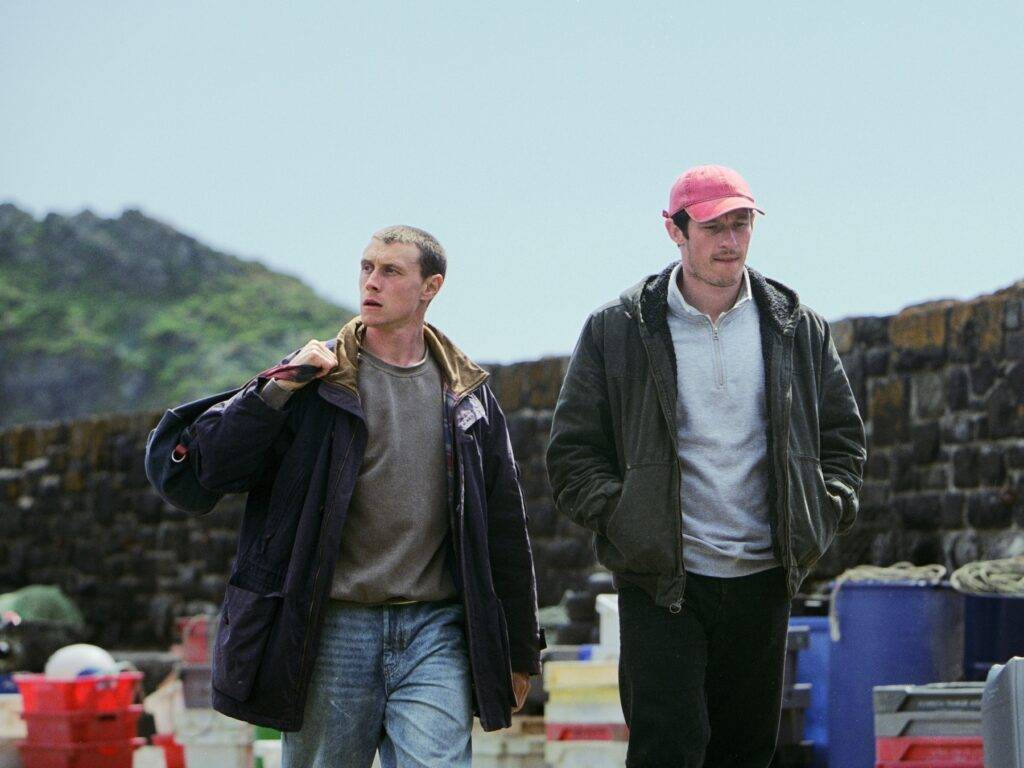
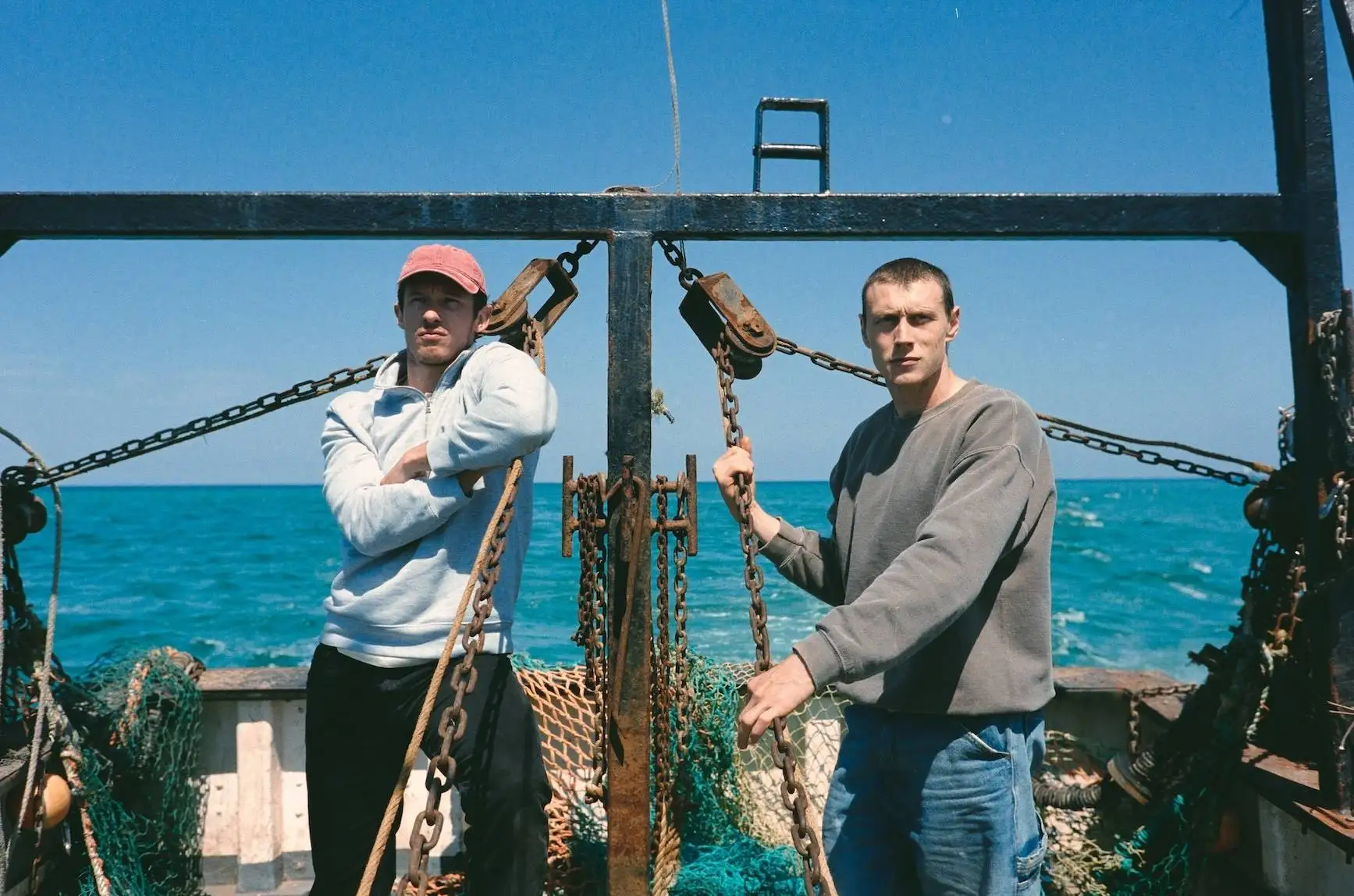
At its core, Rose of Nevada begins with a mystery that feels pulled from maritime folklore. A fishing vessel, lost with all hands three decades earlier, reappears in the harbour of a forgotten Cornish village. For those who remember, it is not just a curiosity, but a sign. The boat must go out again.
Hope, in this world, is fragile and conditional. If the vessel sails once more, perhaps the community’s fortunes will improve. Perhaps something broken can be restored.
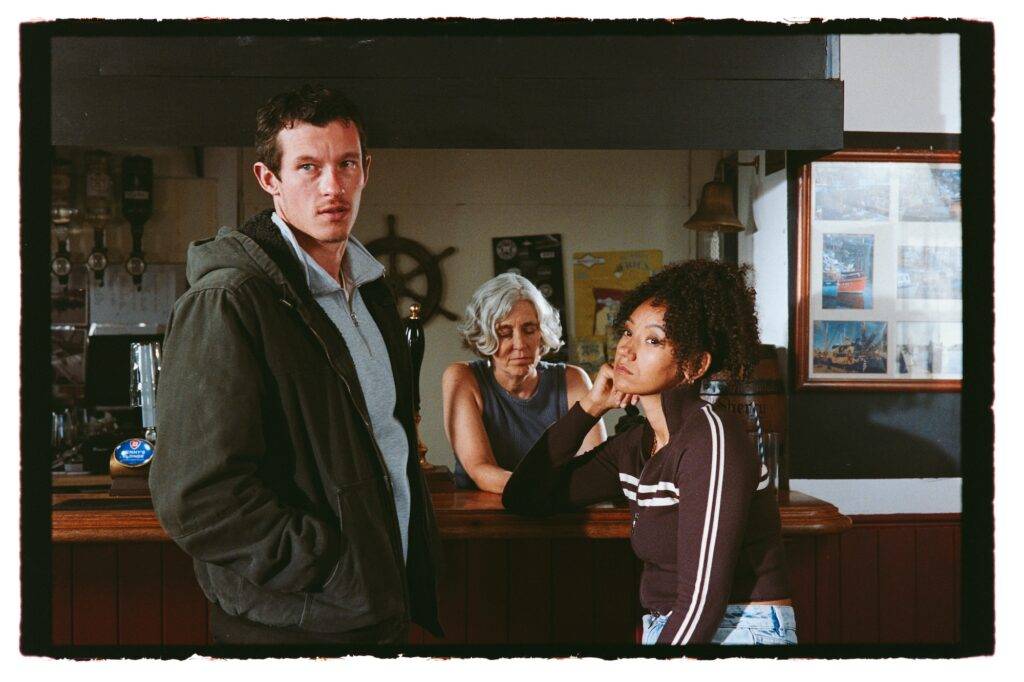
Into this uneasy promise step two men: Nick, a young father desperate to provide for his family, played by George MacKay, and Liam, an enigmatic outsider played by Callum Turner. Alongside a small crew led by a weathered captain, they take the boat out to sea. When they return, the catch is good, but something is very different.
It’s a premise that could easily lend itself to exposition-heavy storytelling. Jenkin, characteristically, refuses that route. It’s in no hurry to reveal itself, keeping the audience guessing to the end. Jenkin laughs. “I’m normally the last person to know what it is that I’ve made.”
Visually, the film is immediately distinctive. Shot on 16mm using a clockwork Bolex camera, its grain, colour, and texture feel almost tactile, something you don’t just watch, but experience. A collage of colours and light, it sweeps from being dark and claustrophobic to exhibiting the same kind of tones you’d find in Martin Parr’s seaside snaps.
“That’s just the camera I use,” Jenkin says, downplaying what might otherwise be considered a bold aesthetic decision. But the framing and blocking is far from incidental. “I photograph people’s faces a lot,” he adds. “So, it really lends itself to portraiture within movies.”
Faces dominate Rose of Nevada. Close-ups linger. Expressions unfold slowly. Emotion is allowed to breathe.
“I like to keep the image still,” he says. “I don’t really like too much unnecessary movement.” Part of that stillness is philosophical. Part of it is mechanical. His choice of camera imposes strict limitations. For instance, its clockwork motor will only run for 27 seconds before needing to be rewound.
The digital age is defined by abundance. If you’re shooting in a digital format, footage can be captured endlessly and refined infinitely. Instead, Jenkin’s approach is rooted in scarcity, and as a result more natural feeling.
“I really love the limitations of shooting on film,” he says. “The tactility of it. The expense of it.” That expense is not just financial, it’s psychological. “Every time I load a roll of film, I’m aware of the cost,” he explains. “So, we shoot in a very sparse way.”
This choice of camera also shapes the entire production process in other ways. When it’s running, it makes a noise, reminding everyone that something is happening. That the moment matters. The result is a heightened sense of presence on set, a collective focus that seeps into the finished film.
“There’s an adrenaline to it,” he adds. “And I think that’s in the work.”
Despite his devotion to film stock, Jenkin is not an absolutist. But he acknowledges the realities of contemporary filmmaking – the need for digital workflows, the dominance of streaming, and the ubiquity of online promotion.
His own process, is something of a hybrid, drawing the best elements from the old and new. Shot on film, processed by Kodak at Pinewood, scanned for editing, and eventually printed back onto celluloid, Rose of Nevada has moved between analogue and digital states.
Sound follows a similarly layered path. Jenkin records dialogue, foley, and score separately, often to tape, before integrating them digitally.
“No sound is recorded live,” he explains. “Everything is built afterwards.” It’s a painstaking process, but one that allows for extraordinary control. “You can build up a naturalistic soundscape,” he says, “and then strip it away.”
That act of subtraction becomes as important as addition. “You can isolate a sound, remove everything else, and suddenly it becomes very abstract. Very emotional.”
While Rose of Nevada has a beautifully simple premise, it is structured as something which is inarguably dreamlike.
“I never really have a film that works until the very final moments,” Jenkin says. Weaving together all the special moments he’s captured, his film’s texture sparkles with shards of experience, glimpses of meaning, and moments that only cohere in retrospect.
A big storm sequence, one of the film’s most ambitious passages, embodies this approach.
“There was no big shot where we knew we had it,” he recalls. “We just had these fragments.” Only in the edit, when sound, image, and performance align, does the sequence come alive. “Suddenly it becomes greater than the sum of its parts.”
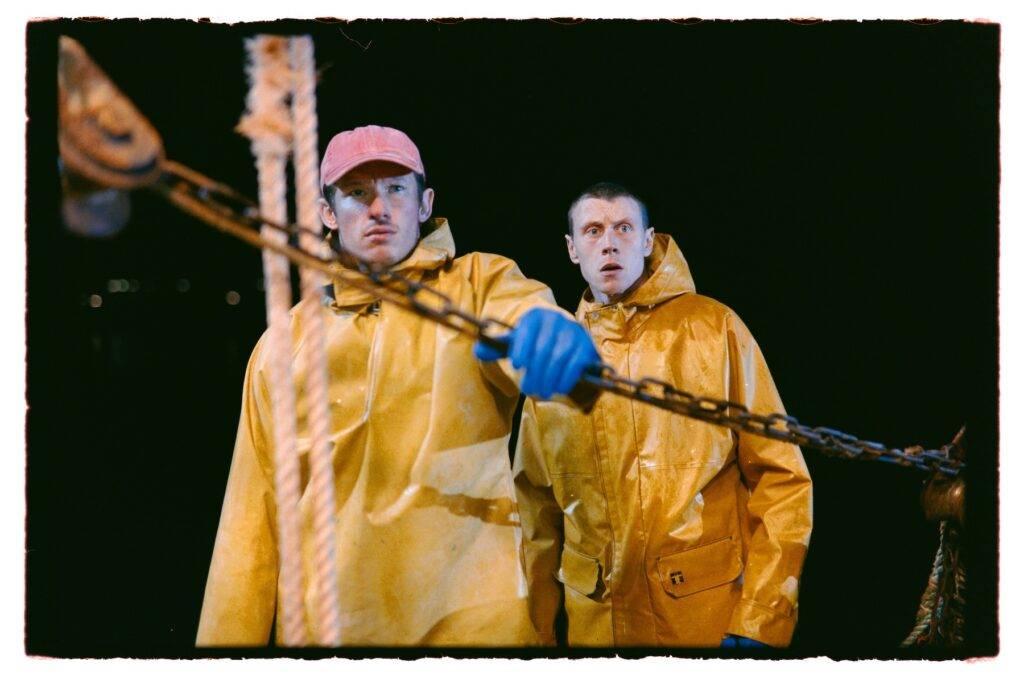
For all its phantastic qualities, Rose of Nevada is grounded in intensely practical filmmaking. Much of the film appears to take place at sea. In reality, the majority of those scenes were constructed through a combination of ingenuity and necessity.
Daytime exteriors were shot on open water. But night-time fishing scenes were filmed in harbour, with the boat tied up. “We attached the net to a speedboat,” Jenkin explains. “And used jet skis to move the water past the stern.”
The illusion of motion is entirely fabricated – and utterly convincing. The storm sequence was created using wave machines, water tanks, and a gimbal-mounted set operated manually by a team of crew members.
“It’s all smoke and mirrors,” he says, with a grin.
Below deck, the boat was reconstructed in a studio, split into sections and rocked by hand.
“It’s so difficult to shoot at sea,” he adds. “You can’t control it.” Except, perhaps, by refusing to shoot there.
If the film’s visuals are carefully constructed, its soundscape is even more so. Jenkin treats sound as a narrative tool in its own right. “You can create a close-up through sound,” he explains. “You can have a wide shot, but isolate one sound, and the viewer focuses on that part of the image.”
This approach allows him to guide attention, shape emotion, and create moments of intense subjectivity. Crucially, it also allows for silence – or near silence. “When you strip everything away,” he says, “it becomes very powerful.”
At the centre of the film are performances that feel raw, immediate, and deeply human. Jenkin credits his leads, George MacKay and Callum Turner, with fully embracing his unconventional process, despite being Hollywood stars.
“They knew how I work,” he says. “They were up for the challenge.” Both actors are enthusiastic cinephiles – deeply engaged with film as an art form. That enthusiasm translated into an ability to adapt, experiment, and immerse themselves in the production.
Their performances anchor a film which is unafraid to be occasionally abstract, grounding its temporal shifts and emotional ambiguities in something recognisably human.
Jenkin’s casting process is instinctive, almost painterly. “I cast people on faces,” he says. “On how they look on film.” It’s an approach that aligns with his broader aesthetic: cinema as a visual and emotional medium first, a narrative one second.
That sensibility naturally lends itself to the uncanny. “I didn’t think I was interested in folklore,” he admits. “But it keeps coming out in my work.” Some elements of Rose of Nevada draw on established traditions. Others are entirely invented, new myths disguised as old ones.
“I suppose every bit of art in that sphere adds to folklore,” he reflects.
Despite its period textures and analogue methods, Rose of Nevada is not a nostalgic film. It is, in many ways, about the persistence of responsibilities, and how communities often rest upon extremely narrow foundations.
That idea is embedded not just in the narrative, but in the filmmaking itself. Jenkin’s process, shooting on film, recording to tape, embracing imperfection, feels like a deliberate resistance to a world frictionlessly moving towards an unidentified goal. As a work, its contemplative and evocative. You can almost smell the harbour and feel the wind in your hair. It’s a view of the world that doesn’t feel embarrassed to be a bit untidy or impolite.
“There’s an imperfection in film that feels human,” he says. It’s this sense of humanity, messy, unpredictable, impossible to fully articulate, that defines both his work and his philosophy.
Does a work which arrives die-cast as intended have any less integrity than something that mutates during production and only reveals its true nature when placed before an audience? No artistic method is the ‘right’ one. Jenkin doesn’t pretend to know. “You can have the greatest script, the greatest cast, the greatest director,” he says. “And still end up with a pretty bad film.”
Conversely, something extraordinary can emerge from the unexpected. An unplanned moment of complete transcendence. It’s in those moments, when image, sound, performance, and light align. Perhaps that’s when cinema reveals its true power.
“You still can’t put into words why it works.”
Perhaps that’s the point. In a world increasingly defined by clarity, explanation, and certainty, we should add greater value to experiences resists all three.
A bag of moments, pieces assembled into something whole. Something felt, rather than understood.
Mark Jenkin’s Rose of Nevada is released in cinemas across the UK & Ireland on Fri 24 April, and on BFI Blu-ray and BFI Player later this summer.